

The world of work as we know it is changing. Companies are being forced to rethink their approach, as the traditional working model has become obsolete for many. Nowadays, employees want to decide for themselves when and where they do their work, rather than being under constant supervision by their line manager whilst on the job. Whilst working from home is already an established practice in the world of work, the term ‘remote working’ is increasingly finding its way into German offices. But what exactly does it mean to work ‘remotely’, and how does it differ from the traditional home office? What are the advantages and disadvantages of this working model? And can we in Germany also benefit from remote working?
What is remote working?
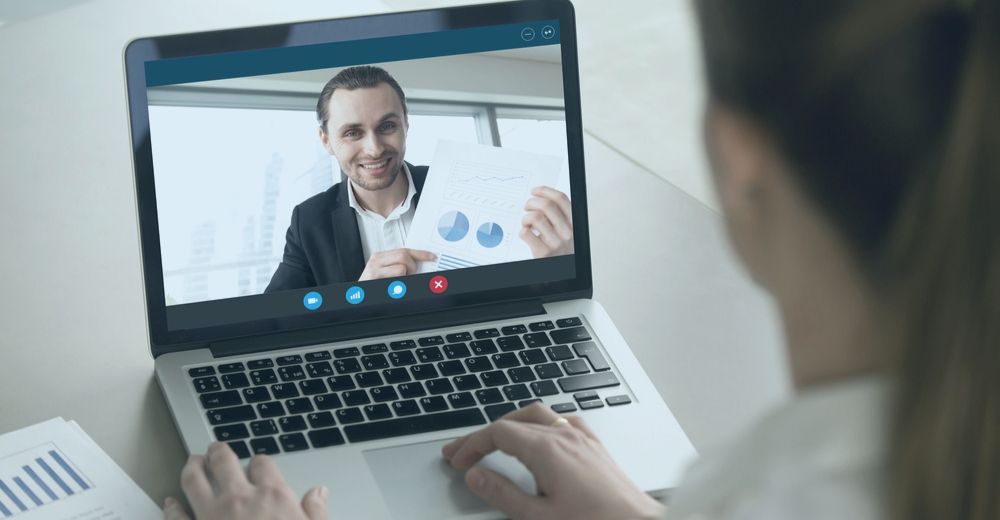
What sounds like a marketing term designed to attract more qualified staff simply means ‘working from a distance’ – just as the ‘remote control’ is called ‘remote’ in English. And that’s why scenarios that sound like something out of a Hollywood film are perfectly normal: in a matter of minutes, management calls via Skype to be briefed on the progress of the website. The web designer gets on with the work from their holiday home overlooking the promenade, whilst the team leader calls directly from the Düsseldorf headquarters. Distance is no problem with the new remote working model. And with a video call, all the important questions about the website and the blog are sorted out. And that is precisely what sets the remote working model apart: so-called remote workers simply choose the working environment that best suits their lives and their jobs. The US is leading the way: around 2.6 per cent of the workforce there are already working remotely.
Definitions of the terms
Freelancer vs. Remote Worker
Does this sound like the life of a freelancer to you? Almost – but there is one crucial difference: if a freelancer finds themselves in a period without projects and subsequent jobs fail to materialise, they run out of money and start to worry about making ends meet. It’s quite different with remote working: here, the employee is tied to the company through permanent contracts and benefits from the advantages of a permanent contract alongside the lifestyle of a freelancer. Coworking spaces are a useful complement to remote working. They combine productivity, community and technology. As freelancers, entire departments or even companies work on different projects simultaneously in the same space, this opens up entirely new opportunities for inspiration, client acquisition and partnerships. Thanks to excellent network connections, co-working provides the perfect foundation for remote working. For companies today, what counts above all is the end result achieved. Where the work is carried out is of secondary importance.
Working from home vs. remote working
So, can remote working be compared to working from home? Not quite, because as the term ‘work from home’ suggests, this involves working exclusively within one’s own four walls, usually on a laptop and by telephone. The biggest difference is that, in a home office arrangement, the employer expects employees to be physically present at the workplace on a regular basis. Often, the ‘work from home’ model is limited to just two days a week. Managers do not like it when staff work entirely from home. This is different with remote working. Here, the work depends 100 per cent on the internet and the telephone and can therefore be carried out from anywhere, whether at a beach house, your favourite café or a co-working space. The employer doesn’t care where the work is done, as long as it gets done. Whilst working from home requires a certain level of mandatory attendance at the workplace, with remote working, companies don’t even provide employees with desks for their jobs. This saves resources and costs. From a business perspective, this is a clear advantage. But be careful: many companies often fail to distinguish properly between the two terms. So, if you’re looking for a new job as a remote worker, you should definitely read the job advert thoroughly before you start work.
Advantages of remote working
Now that the key facts have been clarified, you’re no doubt wondering why jobs offering the option of remote working are so popular. From an employee’s perspective, you can certainly think of a few advantages, but employers can also benefit from this model.
Greater productivity
Remote working has a positive impact on staff productivity, as typical distractions found in an office environment are completely eliminated. Team members do not distract one another whilst working and are not pulled away from their tasks by regular meetings. Studies and surveys support this view. Remote workers have complete control over any sources of distraction and noise pollution in their environment. They minimise these factors so that their concentration isn’t disrupted, allowing them to work in peace. In the office, it is not possible to directly influence these factors, and this has a negative impact on employees’ productivity in their roles.
Cost savings
Not only are office costs eliminated, but so too are additional benefits such as car parking, canteens, service charges, telephones, printers and the associated repair and maintenance costs. This results in substantial cost savings for the company. So when a company takes on a new employee, it’s not just the wage costs that arise, but many small expenses that add up. So why not create remote working roles straight away and make significant savings? Employees don’t miss out either, as commuting costs, for example, are completely eliminated under this model.
However, it must be borne in mind that many of these costs are passed on to the employee if they work from home rather than in a co-working space or business centre. Without financial compensation for these costs, the employee earns significantly less than their colleagues who turn up at the office every day.
More committed employees
It has long been recognised that employees lose their motivation and enthusiasm as a result of commuting to work. And who can blame them? The long journey to and from work is stressful and takes up time and frays the nerves. Anyone stuck in traffic without flexitime is also worrying about their job security. The employee arrives at work already demotivated and dissatisfied and cannot concentrate fully on their work. Despite this, the proportion of commuters is steadily rising. The solution: remote working roles. As well as reducing stress, this model promotes our health, both mentally and physically. The PGi survey shows that 69 per cent of remote workers do not pointlessly put off their work, but instead devote themselves to their tasks with commitment and focus, without feeling stressed or under pressure. Employees carry out their tasks with greater motivation, to a higher standard and more carefully than in jobs under the traditional working model.
Better quality of life
That midday slump sets in. A power nap in the comfort of your own home is no problem. During your break, you can take the dog out for some fresh air and have a quick chat with Grandma on the phone. Pop out to do a bit of shopping for dinner and then get back to work. Any time lost can be easily managed and made up later as required. And the best bit: all this with a relaxed and contented mindset. Speaking of time: because employees can confidently do without the commute, they save several hours a week in the car or on the train – meaning more free time overall for you and your loved ones. Sounds like a dream? Not for remote workers. This new experience of working remotely has a positive effect on work performance and thus satisfies employers and employees alike.

The downsides of remote working
As with all working models, there are also some drawbacks to remote working. We’ll show you not only the bright side of this model, but also the downside and the pitfalls that lie hidden behind this seemingly flawless model.
Communication difficulties
The fact that remote workers aren’t physically present at the workplace makes face-to-face communication within the team more difficult. They don’t attend meetings in person, miss out on important information picked up in the office corridors, and are unable to take part in impromptu team discussions. Of course, the internet provides the perfect platform for video calls, allowing them to take part in important meetings. Nevertheless, so much information flows through a company every day outside of meetings that simply passes remote workers by.
No time to switch off
Remote workers are always online and sometimes work longer hours than in the traditional working model. They often feel as though they are letting their employer down if they do not deliver results as quickly as possible. Shouldn’t it actually be the other way round with remote working? The sad truth is that, when it comes to remote working, the emphasis is actually on the word ‘work’. That’s why it’s important to set a schedule right at the start of the employment relationship, setting out all time slots and deadlines with buffer periods.
Feeling of loneliness
No gossiping about the new recruits, no team lunches, no cosy after-work beer when you’re further afield. The feeling of isolation is arguably the biggest drawback of remote working. Once you’ve experienced it, you’ll miss that sense of camaraderie within the team. In short: when working remotely, it’s just you and your laptop. So make the most of your free time to strengthen your social networks. It would be even better if you occasionally had access to a shared office space so you could mingle with other people.

Bureaucratic hurdles
As promising as the figures from the US may be, progress in Germany is sobering. A breakthrough is still nowhere to be seen in this country. The phenomenon of ‘remote working’ is primarily conceivable only in certain sectors and roles, and is only possible at all thanks to digitalisation. Germany offers a very good infrastructure, particularly in the major cities, and yet success has not materialised. This is primarily due to bureaucratic and legal uncertainties, which can pose a risk to employers.
Yet, particularly in bureaucratic Germany, many legal questions need to be clarified. If charging a mobile phone at work can be classified as theft, does this mean that, in the case of remote working, the employer must also reimburse the costs of electricity, telephone and internet? Does this also require a separate home office to be set up and registered? What is officially defined as a workplace in the contract if the employee does not wish to be tied to a single co-working space or their own desk? And who is liable for accidental damage in the workplace if it cannot be specifically defined? We believe that clarifying the legal framework would encourage more companies to combine jobs with remote working.
Conclusion
Is remote working suitable for all jobs? Jobs that can be carried out primarily on a laptop, PC or tablet are ideally suited to this new way of working. Thanks to broadband connections, cloud technologies and secure data transmission, this is no problem at all. Do you design, write, programme or make phone calls as part of your job, or do you work in online marketing or IT? Congratulations – your job is perfectly suited to remote working. If, for example, you manage your company’s blog, you can do this very conveniently from anywhere, as all you need to create texts and content for a blog is a laptop and an internet connection. This is in contrast to jobs that require a physical presence at the workplace. Tradespeople, retail staff, nursery staff or nurses obviously cannot carry out their jobs from home and are not suited to this new way of working. If you’re someone who places great value on good team dynamics and a strong sense of community, then we’d advise against this model.
You believe that knowledge transfer can only work face-to-face and that the speed of implementation suffers – for example, due to different time zones – which has a negative impact on the work. Unless this fundamental mindset changes, the breakthrough of remote working in Germany will continue to be a long time coming. Are you one of the pioneers bringing remote working into your company? Promote this news through your marketing and you’ll be able to welcome the top talent of the future into your team.
Cover image: Alex Brylov/shutterstock.com